Hammer Forging

Hammer Forge From 1kg

Up to 140kg

Using traditional hammer forging skills to provide quality small components

Hammer Forging Specialists

Somers Forge has over 160 years’ experience in using hydraulic forging hammers, which is the mechanical forming of metal using a hammer. Hammer forging is the modern day version of the pre-industrial blacksmiths work, with a hammer and chisel.
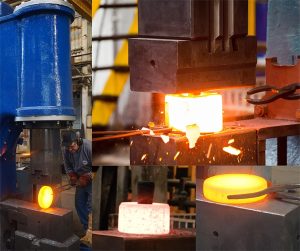
At Somers Forge, our range of hammer forging capabilities allows us to manufacture small components to more complex shapes, all with excellent structural integrity, making them ideal for critical components in the strictest industries.

Hammer Forging Process Explained

The hammer forging process is that of an instantaneous application of pressure in the form of a sudden repeated blow. This metal forming process works when a piece of metal is inserted into a die and then hammered until it has assumed the shape of the die, or it can be manipulated manually without a die. The lower die is a stationary part, while the upper part is a moving hammer dropped onto the workpiece to form it to a near-net shape.

Hammers have been continuously used for both open die and impression die forging for decades. They are generally considered the most flexible amongst the variety of metal-shaping methods available.

Our hammer forging operations at Somers Forge are supported by advanced equipment as well as our team of skilled forgemasters. Whatever component you need, our hammers are capable of meeting the exact specifications. On the hammers we can forge a mix of materials such as carbon steels and alloy steels. This allows us to apply our forging to varying industry standards.

The hydraulic press forging process at somers forge

How are Hammer Forgings Used?

A forging hammer applies energy and causes deformation at very high rates to manipulate the material. They are therefore suitable for alloys that can be deformed rapidly without forming cracks and splits in the workpiece. In general, the hammer forging method is used for small items such as blanks or flanges, with tool time being around 5 minutes for the finished product.

Time is critical to both the quality and longevity of products. Often, items require multi heat processing and will be returned to the hammer forging furnace when necessary to avoid cracking of the material, which would lead to problems later in the manufacturing process. Most items need to forged both very quickly and very accurately, so the experience and skill of the metalworking crew is paramount to the quality of the product.

The applications for the smaller hammer forgings are very varied, ranging from the hard-wearing gear industry right up to the high-integrity aerospace sector. These forgings cover a vast and diverse range of sectors, encompassing both traditional applications up to high end, technological markets. Hammer forgings provide a superior solution compared to closed die forgings or machined bar stock.

Industries That Utilise Hammer Forging

Hammer forging is used widely across high-demand and critical industries. Businesses and sectors that require components that can last and withstand stress. In the aerospace sector, hammer-forged parts are used in structural components and engine systems where strength-to-weight ratio and reliability are critical.

The defence industry relies on hammer forgings for components used in military vehicles and vessels, meaning they demand exceptional durability within extreme operating conditions.

Within the energy and power generation industry, hammer forged components are used in  pressure systems that operate in demanding environments such as high temperatures. The enhanced mechanical properties achieved through forging make these components more reliable and longer-lasting.

Alongside these, many other complex industries benefit from hammer forging. Oil and gas, marine engineering, rail, automotive and heavy industrial machinery are just some examples of these. Across all these sectors, the need for dependable, high-integrity components makes hammer forging an essential manufacturing process.

Hammer forging industries that Somers work with

The Advantage of Hammer Forgings

The process of open die hammer forging can offer several advantages over other methods, such as casting or fabrication.. Due to the refined grain structure and porosity removal, parts are left with a much higher structural strength.

Forged components can also withstand impact and fatigue, allowing them to deal with more demanding environments and high-load applications. The process of hammer forging also produces near-net shapes, which helps to reduce the amount of material waste.

Somers Hammer Forgings

Somers Forge can forge a range of components, from 1 kg to an impressive 140 kg using different hydraulic hammers. All items are forged according to customer requirements, with quantities ranging from a single piece item to short runs, and often just prototype forgings.

Our team is ready to support your next project. Thanks to our years of experience in hammer forging and our specialisation in a diverse range of industries, we’re confident we can help you. Whether you require small batch production or large-scale forging solutions, we can provide a hammer forge service that meets your needs.

Our Industries:

Aerospace | Defence | Rail | Oil & Gas | Power Generation | Nuclear

Additional Links:

Open Die Forged Solutions | Hydraulic Press Solutions | Forged Flanges

Powered by Chameleon
Cropped Somers logo
Privacy Overview

This website uses cookies so that we can provide you with the best user experience possible. Cookie information is stored in your browser and performs functions such as recognising you when you return to our website and helping our team to understand which sections of the website you find most interesting and useful. Find out more in our Privacy Policy.